THE ASSAY: The Asymmetry of Encasement (IEEPA Tariffs & The Major Questions Doctrine)
February 21, 2026
I. THE OMEN (Synthesis)
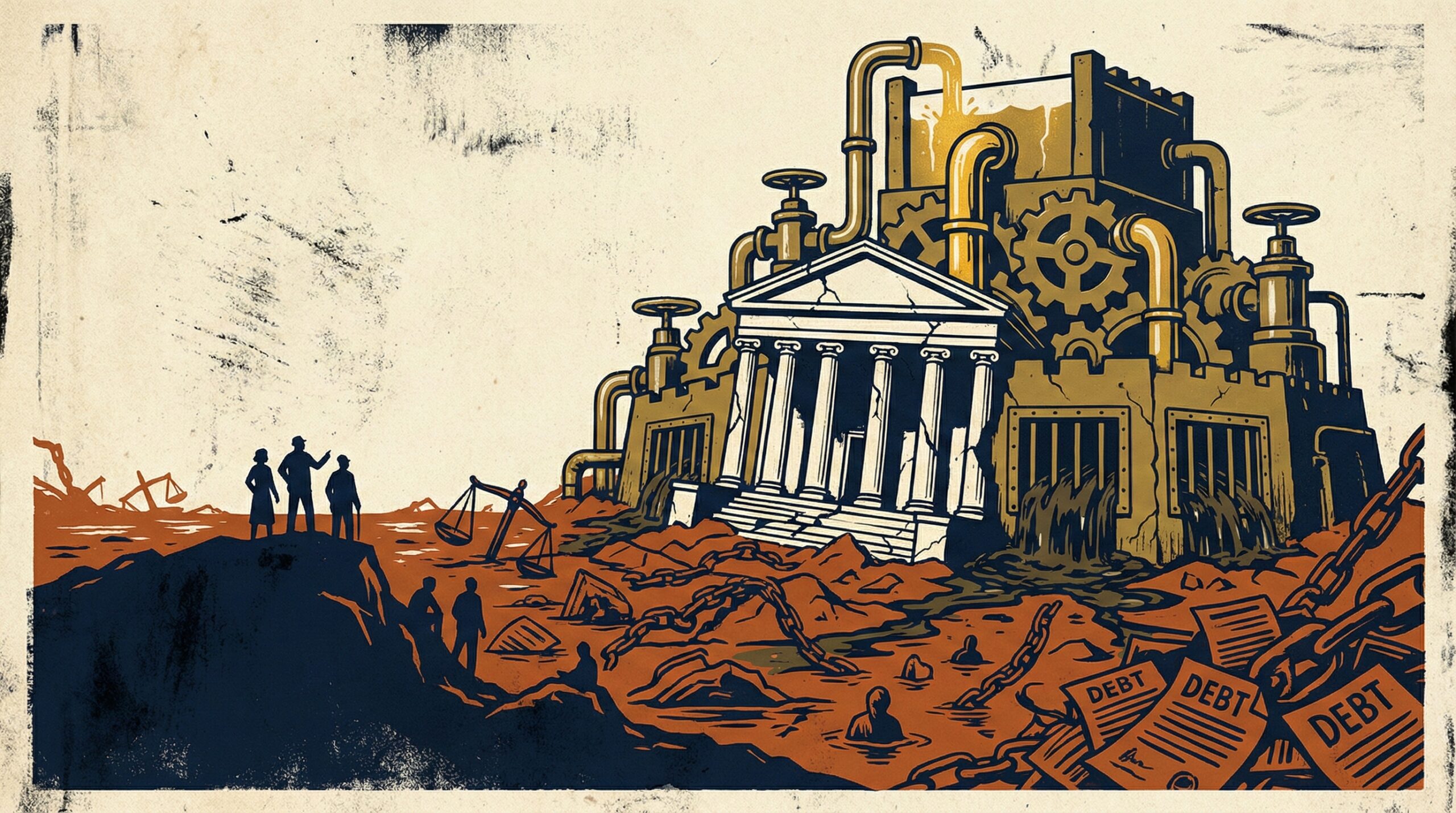
The judicial machinery is currently being celebrated for rescuing the republic from a rogue executive’s trade war, but this apparent symmetry hides a much darker structural thermodynamics. The “Major Questions Doctrine” operates as a directional heat sink: when the state attempts to discharge the unpayable obligations of the public, the emergency brake is pulled to protect the creditor, yet when it strikes down an illegal unilateral tax, the resulting $175 billion Treasury refund is carefully routed exclusively to corporate importers while the citizen permanently absorbs the sunk cost of inflation.
II. THE PRISM (Deconstruction)
The Loom (The Mechanics)
To understand the machine, you must ignore the political theater of “executive overreach” and look at the plumbing of capital accumulation. The Supreme Court’s ruling in Learning Resources Inc. v. Trump acts as a mechanism of Encasement—a juridical firewall designed to insulate the flow of capital from disruption. When the executive bypassed the structural rules of capital by weaponizing the International Emergency Economic Powers Act (IEEPA), the Court applied judicial friction to snap the boundary back, ruling that the power to “regulate importation” does not mean the power to “levy taxes.” But look at the gears: when the HEROES Act was dismantled, the working class retained its debt. When IEEPA was dismantled, the corporate class regained its capital. The consumer, who already paid the price of the tariff at the cash register, is structurally severed from the recovery loop.
The Sword (The Strategic Matrix)
The Weapon: The legal classification of “Importer of Record,” which grants corporate entities the exclusive standing to claim the Treasury refund.
The Game: A sequential game of asymmetric standing. The corporation plays both sides of the board: passing the tax onto the public, then suing the state to recover the very tax the public already paid.
The Wound: The working-class consumer. They act as the heat sink, absorbing the friction of the state’s intervention, but lack the legal handle to pry their stolen capital back from Customs and Border Protection.

The Phantom (The Evidence)
The Test: If the tariffs are struck down as an illegal use of emergency powers, who gets the $175 billion the government collected?
The Verdict: The Omission Strategy. The media narrative loudly broadcasts the “defeat” of executive overreach and the triumph of the separation of powers. The void is the absolute silence regarding the socialization of the cost. Contract lawyers are currently mobilizing to ensure B2B supply chains hoard the refunds, omitting the citizens who actually funded the Treasury’s temporary coffers.
III. THE SOLVENT (The Precipitate)
The Major Questions Doctrine is not a doctrine of constitutional originalism; it is a doctrine of Encasement. It exists to protect fictitious commodities (land, labor, and capital) from the volatile reach of mass democracy or rogue executive populism. When the HEROES Act threatened to discharge the debt of the working class, the doctrine was invoked to protect the creditor. When the IEEPA tariffs threatened to disrupt the global flow of cheap goods, the doctrine was invoked to protect the importer. The legal logic shifts, but the vector of capital accumulation remains constant. The machine uses the rhetoric of “congressional authorization” to disguise a massive, unrecoverable wealth transfer.
IV. THE LEDGER (The Receipt)
DEBIT (The Cost): The Working Class, who bled billions into the system via stealth point-of-sale inflation and retained their student debt.
CREDIT (The Profit): The Corporate Class (Creditors and Importers of Record), positioned to harvest a monumental legal windfall from the Treasury without lowering historical retail prices, while their debt assets remain fully intact.
NET VERDICT: The judicial application of the Major Questions Doctrine operates as a one-way valve, routing extracted capital upward into corporate treasuries while leaving the public permanently dispossessed.
V. THE ELIXIR (Hearth & Hammer)
The Hammer (Disruption): Interoperable Consumer Standing. Legally mandate class-action standing for end-consumers to freeze and intercept corporate tariff refunds at the Treasury level before they are disbursed to the importers of record.
The Hearth (Restoration): The Digital Receipt Commons. Construct a transparent, cryptographically verified ledger linking import duties directly to retail price hikes, ensuring that if a state tax is refunded, the capital mathematically follows the exact path of extraction back to the citizen’s wallet.
VI. THE REALITY SCORECARD
| Metric | Score (1-10) | Notes | The Archive (Live Search URLs) |
|---|---|---|---|
| Friction Index | 9/10 | The refund process is a labyrinth of contract reconciliation designed to keep capital entirely within B2B channels. | Thomson Reuters Legal Analysis |
| Extraction Index | 10/10 | Consumers bore the overwhelming burden of the cost, while importers will reap the legal rebate. | Crowell & Moring LLP IEEPA Breakdown |
| Game Theory Risk | 9/10 | Total corporate defection. The dominant strategy is to capture the refund and maintain inflated retail prices. | Brookings Institution Tariffs Impact |
FINAL STAMP
CAUTION